
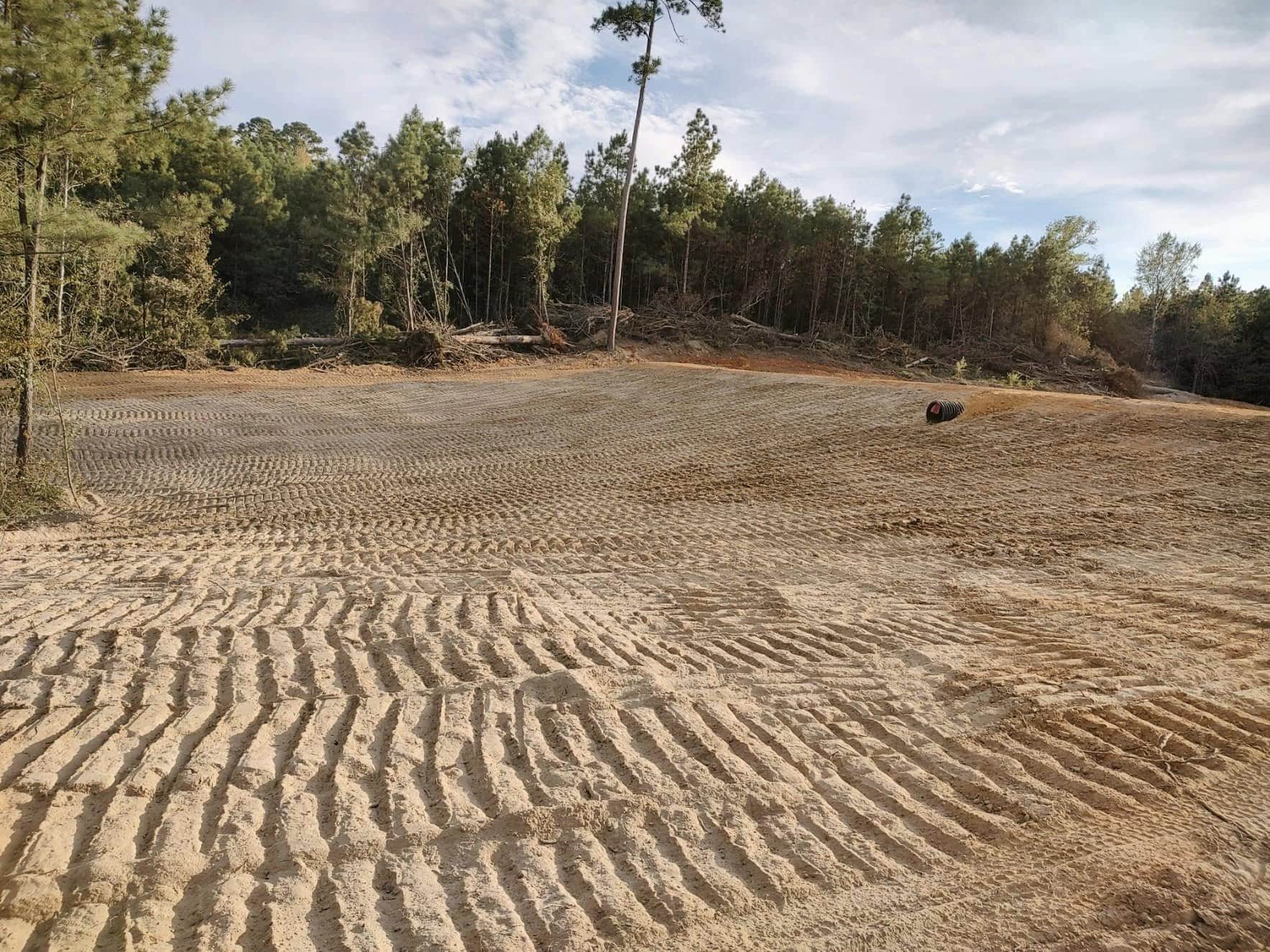
Land needs four steps before it’s ready for a house: clearing, grubbing, grading, and soil testing, done in that order. Skip one, and the problems show up later as drainage issues, sinking floors, or a soil report that stops your build before it starts.
Did You Know: Henderson County spans everything from sandy-loam timberlands in the east to dense, clay-heavy “claypan” soils elsewhere in the county. That’s one reason a soil test matters here more than in areas with a single, uniform soil type.
The Four Steps That Come Before Construction
Site prep for a new home follows a set order for a reason. Each step depends on the one before it. Clearing removes what’s on top of the ground. Grubbing removes what’s just below it. Grading shapes the land so water moves the right direction. Soil testing confirms the ground underneath can actually hold the weight of your home. Do them out of order, and you’ll likely redo one of them.
Here’s the order at a glance:
- Clearing – Remove trees, brush, and surface debris from the build area and access routes.
- Grubbing – Remove root systems and buried organic material that clearing leaves behind.
- Grading – Shape and slope the land so water drains away from the future foundation.
- Soil testing – Confirm the compacted ground can support the weight of your home before the foundation design is finalized.
Our Land Clearing team handles the first two steps as part of the same visit in most cases, since grubbing is really an extension of clearing rather than a separate job.
Step 1: Clearing Comes First
Clearing removes trees, brush, stumps, and debris sitting on the surface. For a home build, this usually means clearing the full footprint of the house pad plus enough room around it for equipment access, a driveway, and any utility runs. Most residential lots take one to three days to clear, depending on vegetation density and terrain.
The goal here isn’t just an empty lot. It’s a lot that’s actually usable. Piled brush, standing dead trees near the build zone, and leftover debris all need to go before grading equipment can move in. Our complete guide to land clearing methods and costs breaks down the different clearing methods and what drives price if you want the full picture before this step.
Step 2: Grubbing Removes What’s Left Behind
Grubbing is the part most first-time landowners haven’t heard of. It’s the removal of roots, stumps, and buried organic material that clearing alone leaves behind. A cleared lot can look ready. It usually isn’t.
Roots don’t stop at the trunk. Large trees can send root systems out well beyond where the branches end, and the biggest ones usually sit just a foot or two below the surface. If a footing or slab goes in over an unremoved root system, it decays over years and leaves a void under the foundation. That’s a structural problem hiding under a lawn, and one that’s far cheaper to fix now than after the concrete is poured.
Pro Tip: Ask your contractor if grubbing is included in the clearing price or billed separately. It’s a common line item that gets left off cheaper bids, and it’s not a step worth skipping to save money.
Step 3: Grading Shapes the Land for Drainage
Grading levels and slopes the land so water moves away from where your house will sit instead of pooling against it. This isn’t optional or cosmetic. Building codes require it. The International Residential Code calls for the grade to fall at least 6 inches over the first 10 feet away from the foundation, and for any paved surface near the house to slope at least 2 percent away from it, according to the International Code Council.
On a cleared but ungraded lot, water follows whatever low points already exist. That’s rarely where you want it. Grading also builds the compacted base that later becomes your house pad, so this step and pad construction often overlap on a build timeline.
Step 4: Soil Testing Confirms What’s Underneath
Soil testing tells you what the ground can actually support before you commit to a foundation design. It checks for expansive clay, compaction rates, and load-bearing capacity, all things that vary across a single property, especially in East Texas.
We’ve walked lots that looked perfect on the surface. Clearing was clean. Grading was even. Then a soil test came back showing expansive clay in the exact corner where the garage was planned to sit. That one test saved a redesign after the slab was poured, not before. It’s a small cost early that avoids a large one later.
For property owners who want a first look at what’s under their lot before hiring anyone, the USDA’s Web Soil Survey lets you pull general soil composition data, including building-site suitability ratings, for any specific property. It’s a helpful starting point, but it doesn’t replace a formal geotechnical soil test, which your builder or engineer will still require for the actual foundation design.
Did You Know: A soil test typically takes one to two weeks for results, so building it into your timeline early prevents it from becoming the thing that delays your permit or your builder’s start date.
What Happens When You Skip a Step
Most delays we see on new builds don’t come from bad weather or slow permitting. They come from a step that got skipped to save a week or a few hundred dollars early on. A lot that’s cleared but not grubbed means a foundation crew hitting roots they didn’t expect. A lot that’s graded but never soil tested means a builder’s engineer asking for a report that doesn’t exist yet, which pauses everything until it does. We’ve seen both scenarios push a build back by weeks, all to save a step that costs far less than the delay it causes.
The order exists because each step catches something the last one couldn’t. Following it isn’t the slow way to prep a site. It’s the way that avoids redoing work you already paid for.
Ready to Prep Your Site the Right Way?
Preparing land for a new home isn’t just about clearing space. It’s clearing, grubbing, grading, and soil testing, in that order, so every step after breaking ground goes smoothly. Getting this sequence right upfront saves time, money, and headaches once construction starts.
Kingdom Land & Construction handles full site prep for new home builds across Athens and East Texas, from the first clearing pass through final grading. Ready to start? Get a free quote from Kingdom Land & Construction today.
Frequently Asked Questions
What is the correct order for preparing land for building? The correct order is clearing, grubbing, grading, and soil testing. Each step depends on the one before it, and doing them out of order usually means redoing work later.
Do I need a soil test before building a house in Texas? Most builders and engineers require a soil report before finalizing a foundation design, especially on East Texas properties with variable clay content. It’s not always legally required, but skipping it is a real risk.
How is grubbing different from land clearing? Clearing removes what’s visible above ground, like trees, brush, and debris. Grubbing removes what’s left below the surface, including roots and stumps, which clearing alone doesn’t reach.
How long does site prep take before construction can start? For a typical residential lot, clearing and grubbing take one to three days, grading takes another one to two days, and soil testing adds one to two weeks for lab results. Total timeline runs two to three weeks for most properties.
Can I skip grading if my lot already looks level? No. A lot can look level and still lack the slope building codes require to move water away from a foundation. Professional grading confirms the correct fall and compaction, not just a flat appearance.