Building a pond starts long before excavation. The right site, water source, soil, drainage plan, finished use, and maintenance expectations all need to work together before equipment moves onto the property.
A successful pond project usually follows this sequence: define the purpose, review the property, choose a pond type and layout, plan excavation and water management, build stable banks and spillways, then maintain the finished water feature. The exact design depends on the land, not just the size of the pond you want.
Kingdom Land & Construction builds and restores ponds and small lakes in Athens and surrounding East Texas communities. Its pond services include new pond and lake construction, excavation and site grading, water-management planning, compaction and liner options, erosion control, and pond expansion or restoration. Request a site-specific review before treating any general pond size, depth, or timeline as a promise.
Start With What You Want the Pond to Do
The best pond design begins with the intended use. A pond for livestock watering has different priorities from a fishing pond, a decorative water feature, an irrigation resource, or a recreational lake. Some properties need one pond to serve several purposes, but those uses still need to be discussed before the design is set.
Stock or livestock pond
A stock pond may be designed around reliable access for livestock, water availability, durable banks, and manageable maintenance. Fencing, watering points, bank traffic, sediment control, and safe access can affect the layout. A pond that looks attractive from a distance may not function well if animals repeatedly damage the shoreline or muddy the water source.
Fishing or recreational pond
A fishing pond needs more than an open hole that holds water. Depth changes, shoreline shape, habitat, water quality, access, and future stocking plans all matter. The design should reflect who will use the pond, whether boats or docks are planned, and how the property owner expects to manage vegetation and water levels over time.
Decorative water feature
A decorative pond may emphasize views, the relationship to a home or gathering area, shoreline appearance, and controlled water levels. A liner or other water-retention approach may be considered when the native soil and intended design do not support a naturally sealed basin. Access for future maintenance should be planned at the same time as the visual layout.
Irrigation or practical water resource
A pond intended to support irrigation, fire protection, or another practical use requires a careful review of water demand, storage, drainage, access, and applicable rules. The property owner should not assume that a pond automatically creates an unrestricted water right or that a planned volume is available for every use. Confirm requirements with the appropriate state, local, or professional authority before construction.
Did You Know: The same pond can serve more than one purpose, but those uses can pull the design in different directions. Livestock access, fishing habitat, decorative shoreline treatment, and irrigation drawdown should be discussed together rather than added one at a time after excavation starts.
Review the Property Before Choosing a Pond Location
The most attractive low spot on a property is not automatically the best pond site. A pond location needs enough water supply, suitable soil, workable access, manageable drainage, and room for construction and maintenance.
Understand the drainage area
Many ponds depend partly or entirely on runoff from surrounding land. That makes the drainage area important. A watershed that is too small may not fill the pond reliably. A watershed that sends large flows toward the pond may require more substantial spillway and erosion-control planning.
Walk the property after rain if possible. Note where water collects, how fast it moves, whether it carries sediment, and whether nearby roads, driveways, fields, or cleared areas change the flow. Existing ditches, culverts, creeks, and low crossings can affect the proposed location.
A site review should also consider what happens downstream. Water leaving the pond needs a safe path that does not undermine the embankment, erode a neighboring area, or create a new drainage problem.
Check soil and water-retention conditions
Native soil strongly affects whether a pond can hold water. Clay-rich material may support natural sealing when properly placed and compacted, while sandy, gravelly, fractured, or highly permeable soils may require another water-retention strategy. Soil can vary across a single property, so a general statement about the region is not a substitute for a site-specific review.
The USDA Natural Resources Conservation Service describes ponds as water impoundments created through excavation, an embankment, or a combination of both. Its Ponds — Planning, Design, Construction handbook emphasizes site-specific planning, soil conditions, drainage, spillways, and applicable laws.
A pond contractor may discuss clay compaction or liner options after reviewing the site. Neither option should be promised before the soil, water source, intended depth, and construction method are understood.
Plan access and staging
Pond building requires equipment to reach the work area. Gates, fences, overhead lines, steep approaches, soft ground, existing structures, and narrow driveways can affect the work plan. The route for excavators, dozers, trucks, and material deliveries should be considered before the pond footprint is finalized.
Staging space also matters. Soil excavated from the basin may be used in an embankment or placed elsewhere on the property, but there needs to be a plan for suitable material, unsuitable material, trees, stumps, brush, and debris. If the pond site is heavily overgrown, clearing and mulching may need to happen before excavation.
Kingdom’s land clearing services include brush and vegetation clearing, tree and stump removal, grading, site preparation, and clearing for construction. Its forestry mulching services may fit some brush-reduction needs, although mulching is not a replacement for every excavation or pond-preparation step.
Pro Tip: Photograph the proposed access route, the lowest areas, the surrounding slopes, existing drainage paths, and the intended finished view before requesting an estimate. Those images help start the conversation, but they do not replace a property walk.
Choose the Pond Type and Basic Layout
Ponds are commonly built by excavating a basin, creating an embankment, or combining excavation with an embankment. The right approach depends on the existing landform, drainage, soil, desired storage, and finished use.
Excavated ponds
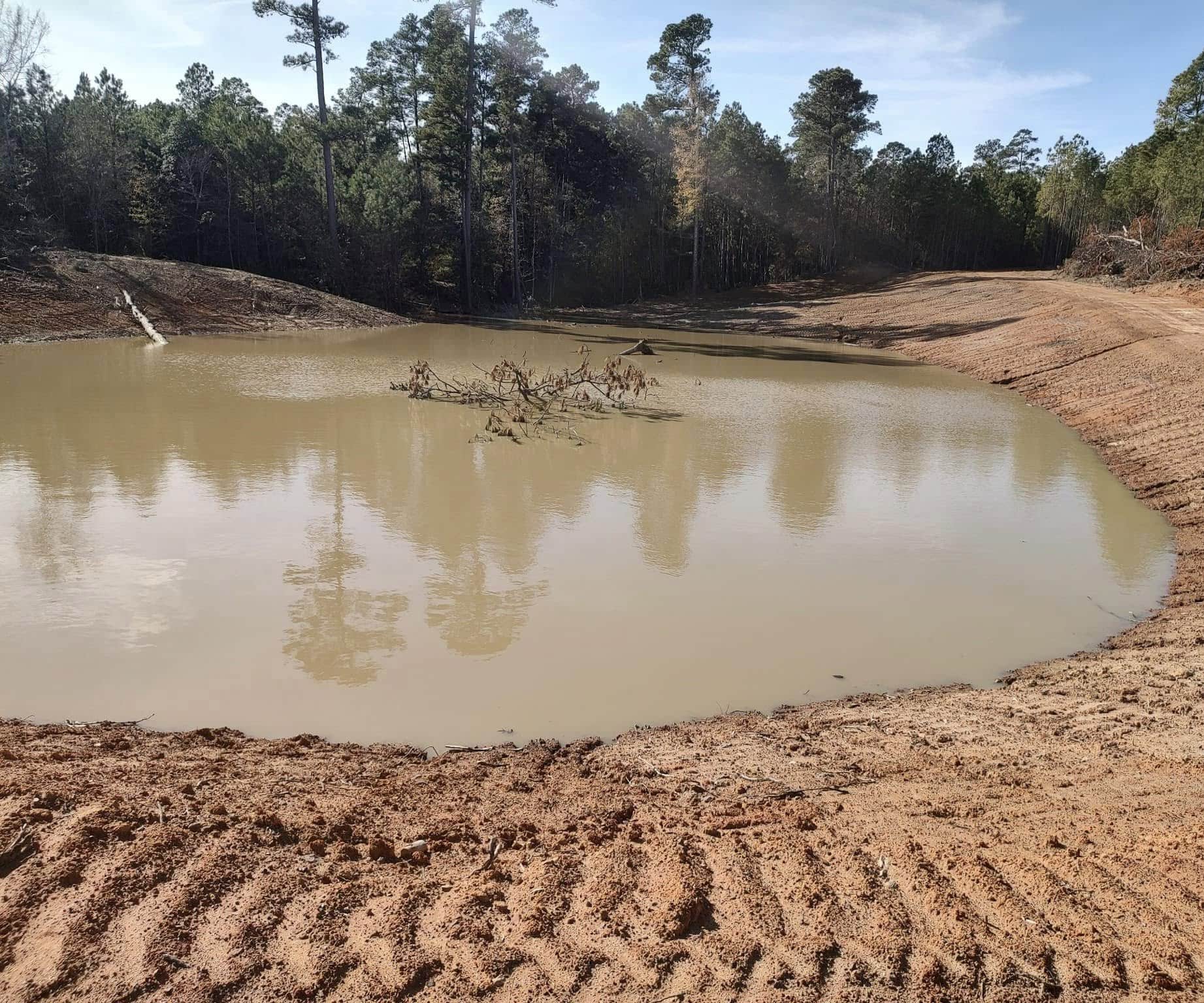
An excavated pond is formed by removing soil from the basin. This approach may work where the terrain and soil support the desired depth without relying on a large dam. The amount and quality of excavated material still need to be planned, as does the final slope and stability of the basin.
Embankment ponds
An embankment pond uses a constructed dam or raised earth structure to hold water. The embankment, foundation, compaction, spillways, and downstream side require careful planning. An embankment is not simply a pile of dirt pushed across a low area. It needs suitable material placed and compacted in a controlled way, with water routed safely around or through the structure as designed.
Combined designs
Some projects use both excavation and embankment work. Excavated material may help form or extend an embankment, while the basin is shaped to create the desired depth and shoreline. The final plan should identify where suitable material comes from, how it will be placed, and how drainage will be managed during and after construction.
Shoreline shape and access
A pond with irregular coves may create more shoreline and visual interest, but it can also create more areas to maintain. A simple shoreline may be easier to mow, inspect, and access. Slopes should be designed for stability and for the expected use of the pond, including people, livestock, equipment, and future maintenance.
Consider where a property owner will stand, fish, launch equipment, inspect the dam, mow, manage vegetation, or access a spillway. A pond that cannot be safely reached is harder to maintain and harder to evaluate after a major storm.
Plan Size and Depth Around the Property
There is no universal pond size or depth that works for every Texas property. The dimensions depend on the intended use, available drainage, soil, water source, topography, evaporation, sediment, and the finished level of water the owner expects.
A larger pond is not automatically more reliable. It may require more excavation, a larger drainage review, more material handling, and more ongoing maintenance. A smaller pond can still perform well when it is located and designed around the property.
Depth should be discussed with the intended use in mind. A fishing pond, livestock pond, and decorative pond may have different depth and edge requirements. If a pond is expected to hold water through dry periods, the design should account for inflow, evaporation, seepage, sediment storage, and the amount of water the property owner plans to remove.
Do not treat an online depth number as a guarantee. A contractor or qualified designer needs to evaluate the site before confirming what is practical. If fish habitat, irrigation, drinking water for livestock, or recreational access is part of the plan, those requirements should be included at the beginning.
Understand the Excavation Process
Every site is different, but a pond project commonly moves through several stages.
1. Site review and project definition
The first step is identifying the property, access, intended use, proposed location, drainage, soil questions, existing vegetation, and desired finished condition. This is also the point to identify utilities, structures, septic systems, wells, easements, property lines, and areas that should remain undisturbed.
2. Clearing and preparation
Trees, brush, stumps, and debris may need to be removed from the basin, embankment area, access route, and staging area. The correct scope depends on whether material will remain, be processed, be stacked, or be hauled away. Clearing for a pond is not always the same as clearing an entire property.
3. Excavation and material handling
Excavation shapes the basin and produces soil that may be useful elsewhere. Equipment selection depends on access, soil, rock, depth, slope, and the quantity of material to move. The plan should account for unsuitable material rather than assuming all excavated soil can be used in an embankment.
4. Embankment, banks, and compaction
Where an embankment is part of the design, suitable material must be placed and compacted so the structure can perform as intended. Bank slopes and transition areas should be shaped for stability, drainage, access, and erosion control. Compaction is not just a finishing pass. It is part of the water-retention and structural plan.
5. Spillway and water-management work
Water needs a safe route during high-flow conditions. The principal outlet, auxiliary spillway, drainage paths, and erosion protection depend on the pond design and site conditions. A spillway that is too small, poorly located, or left unprotected can create serious problems during a storm.
The NRCS Conservation Practice Standard Pond, Code 378 describes the importance of planning for spillways, freeboard, sediment, outlet works, and compliance with federal, state, and local requirements. The standard is not a substitute for a Texas site design, but it illustrates why water-management components must be considered before excavation.
6. Erosion control and finish work
Freshly disturbed soil is vulnerable to runoff. Banks, spillways, slopes, access paths, and other disturbed areas may need shaping, vegetation, rock, or another stabilization approach. The final treatment depends on soil, slope, rainfall, intended appearance, and how quickly the area needs to become usable.
7. Initial filling and inspection
A new pond may fill gradually through runoff, groundwater, pumping, or another planned source. The property owner should understand what filling conditions are expected and how the pond will be monitored during the first storms and the first dry period. The dam, spillway, banks, outlets, and areas of seepage should be inspected as part of ongoing ownership.
Did You Know: A pond can look finished before it is fully proven. Early inspections after substantial rain and during the first period of low inflow can reveal erosion, settlement, blocked outlets, or water-retention concerns while they are still easier to address.
Water Retention: Clay, Compaction, and Liners
Water retention is one of the most common concerns in pond planning. The basin needs a way to hold water under the actual soil and water conditions of the site.
Clay compaction
Where suitable clay material is available, a contractor may recommend placing and compacting it in planned areas of the basin or embankment. The result depends on the material, moisture, lift thickness, compaction method, underlying soil, and construction quality. “There is clay somewhere on the property” does not automatically mean the proposed pond will seal naturally.
Liner options
A liner may be considered where native soil is too permeable or where the design calls for a controlled water-retention layer. Liner suitability depends on the pond shape, substrate, protection from puncture, installation details, and the way edges and penetrations are finished. It is a project-specific option, not a universal fix.
Water source and seepage
A pond may lose water through evaporation, seepage, outlet flow, or a combination of factors. Water levels also rise and fall naturally with rainfall and use. Before construction, discuss the expected water source, the desired normal pool, drought conditions, and how the pond will be evaluated if it does not fill as expected.
Kingdom’s pond service page identifies compaction and liner options as part of its pond work, but the appropriate method still depends on the property. A responsible estimate should explain what is known, what needs testing, and what result is being targeted without promising that every pond will hold water at the same level.
Build Erosion Control Into the Design
Pond problems often begin with water moving too quickly or soil remaining exposed too long. Erosion control should be considered around the basin, embankment, spillway, inlet, outlet, access path, and disturbed slopes.
The design may include shaped banks, protected spillways, vegetation, controlled drainage, or other stabilization methods. The right treatment depends on flow, slope, soil, expected traffic, and local conditions.
Vegetation around a pond should be managed intentionally. Some plant growth can help stabilize soil, while invasive or excessive growth can limit access, affect water quality, or reduce the useful capacity of the pond. Inspect the edges and drainage paths after major rain instead of waiting for a visible failure.
If the pond is near a home, road, property line, creek, or downstream structure, the consequences of erosion deserve extra attention. Make sure the contractor and any engineer or permitting authority have the same understanding of where water should go in an ordinary storm and during a larger event.
Permits, Utilities, and Professional Review
Pond construction can involve more than excavation. The applicable requirements depend on the location, size, dam or embankment characteristics, drainage, water source, wetlands or waterways, downstream risk, and intended use.
Before work begins, confirm the need for utility locating, local approvals, environmental review, water-rights review, stormwater requirements, or other permits with the appropriate authority. The Texas Commission on Environmental Quality water-rights guidance explains that surface-water use can require state permission unless an exception applies. That page is a starting point, not a project-specific legal determination.
A qualified professional may be appropriate when the project involves a substantial dam, complex drainage, a waterway, wetlands, public safety concerns, significant downstream exposure, or a planned water use that needs formal review. A contractor can help identify questions, but property owners should not assume an estimate replaces engineering, permitting, or legal advice when those are required.
Also locate buried utilities, septic components, wells, drainage structures, and easements before excavation. Mark areas that should not be disturbed. A pond plan that ignores an existing utility or drainage feature can create a larger and more expensive project than expected.
Maintenance Starts Before the Pond Is Finished
A pond is an ongoing property feature, not a one-time excavation. Maintenance planning should be part of the design discussion.
Inspect the dam and banks
Walk the dam and banks regularly. Look for erosion, animal damage, wet spots, settlement, cracks, blocked outlets, or areas where water is moving outside the intended path. Do not wait until a small issue becomes a washout.
Watch water levels and clarity
Keep a simple record of water levels, rainfall, unusual inflow, and visible changes. A falling level can have several explanations, including drought, evaporation, seepage, outlet flow, or increased use. Records help separate normal seasonal change from a new problem.
Manage vegetation
Keep the spillway, outlet, access route, and inspection areas visible and usable. Vegetation management around the shoreline should reflect the pond’s purpose. Avoid making assumptions about herbicides or treatments without identifying the plant, the water use, and the applicable label and professional guidance.
Control sediment
Sediment enters from the drainage area, exposed soil, roads, construction, and eroding banks. Reducing upstream erosion can protect the pond’s useful capacity. If sediment has already accumulated, removal may require a separate plan for access, dewatering, material placement, and environmental considerations.
Plan for drought and heavy rain
A good maintenance plan considers both extremes. Dry conditions can reduce inflow and increase evaporation. Heavy rain can test the spillway, outlets, banks, and upstream drainage. Inspect after significant storms and keep access available for corrective work.
Texas A&M AgriLife Extension maintains pond-management resources covering pond management topics for recreation and food production. Those resources can help property owners identify questions for a contractor, fisheries professional, or other qualified advisor.
Questions to Ask Before Hiring a Pond Contractor
Before signing a pond-building agreement, ask:
- What is the proposed use of the pond, and how does that use affect the design?
- How will the site be evaluated for drainage, soil, access, and water retention?
- What happens to excavated material, trees, stumps, brush, and unsuitable soil?
- What type of compaction, liner, spillway, outlet, and erosion-control work is included?
- What is the expected finished condition, and what is not included?
- What weather, soil, water-level, or access conditions could change the schedule?
- Which permits, utility locates, engineering reviews, or agency approvals need to be handled before work begins?
- How will the finished pond be inspected and maintained after construction?
A clear scope makes it easier to compare estimates. It also helps prevent a common misunderstanding: excavation alone is not the same thing as a complete pond project.
Frequently Asked Questions
How do you know where to build a pond?
The best location depends on the intended use, drainage area, soil, water source, topography, access, utilities, property features, and downstream conditions. A low spot may be a starting point, but it still needs a site-specific review before the location is confirmed.
Will a new pond automatically hold water?
No. Water retention depends on native soil, compaction, seepage, inflow, evaporation, the basin design, and sometimes a liner or other treatment. A contractor should review the property before promising a water level or recommending a construction method.
Is pond excavation the same as pond construction?
No. Excavation is one part of pond construction. A complete project may also involve clearing, material handling, embankment work, compaction, grading, spillways, outlets, erosion control, water-retention measures, and finish work.
What type of pond is best for a Texas property?
The best type depends on the property and intended use. A stock pond, fishing pond, decorative pond, irrigation pond, and recreational pond may require different layouts, depths, access, water-management features, and maintenance plans. The right answer comes from reviewing the site rather than choosing a type by name alone.
Can an existing pond be repaired or expanded?
Often, an existing pond can be evaluated for expansion, deepening, reshaping, restoration, erosion control, or improved water management. The condition of the basin, dam, spillway, access, soil, and drainage should be reviewed before the scope is defined.
Plan a Pond Around Your Property
A pond works best when its design matches the land, the water, and the reason you want it built. Start with the finished use, then review the site, soil, drainage, access, excavation plan, embankment or basin, water-retention approach, spillways, erosion control, and long-term maintenance.
Kingdom Land & Construction provides pond and lake construction, excavation and grading, water-management planning, compaction and liner options, erosion control, and pond restoration in Athens and surrounding East Texas communities. Request a free estimate to discuss the property and the result you want before the project is scoped.